1Jilin University2Institute of Automation, Chinese Academy of Sciences3Southwest University4University of Sydney5Tencent Youtu Lab6Huazhong University of Science and Technology7United Arab Emirates University8Shenzhen University9Vast Intelligence Lab
* Equal contribution · † Corresponding authors
01
Start with an imageNo user-provided textual claim
required.
02
Investigate the factsConnect visible details to
external evidence.
03
Explain the verdictA compact 9B policy, trained to
investigate.
THE QUESTION
Verify the situation. Not just the image’s origin.
A genuine photograph can be misleading. A generated image can depict
a factually consistent scene. Origin and factuality are different
questions.
INPUT
An image
Identify the people, objects, events, text, and context that can
be checked.
INVESTIGATION
Evidence, not appearance
Find sources and inspect whether their details actually match the
depicted situation.
OUTPUT
A grounded assessment
SupportedRefuted
With an explanation tied to the evidence.
View the task definition from the paper
THE EVISCENE AGENT
Look closer. Follow the evidence.
A multimodal ReAct policy chooses what to inspect, where to
search, and when the evidence is sufficient to conclude.
01 OBSERVE
Inspect the image
Read the scene and its details. Surface specific, checkable cues
rather than relying on visual plausibility.
Scene perception · Focused inspection
02 RETRIEVE
Find the context
Search the web and retrieve related images to identify relevant
events, entities, and sources.
Web search · Image retrieval
03 VERIFY
Check the match
Visit source pages and compare reference images. Test dates,
identities, and details against the input.
Page visits · Reference comparison
04 DECIDE
Revisit and conclude
Resolve open questions, then produce a verdict supported by the
collected evidence.
Reasoning · Evidence-grounded verdict
↺ An investigation loop, not a fixed
checklist. The policy can revisit observations as new evidence
arrives.
Explore the complete agent architecture
THE BENCHMARK
Meet EviLens.
A benchmark designed to test factuality across both web-sourced and
controlled images—not just whether an image was generated.
10,174Images in the benchmark
1,527Test images
12Factual error types
2Acquisition sources
A
Event & relation
What happened, and between whom?
Invented action
Invented interaction
Impossible state
False official record
B
Attribute & detail
Do the visible details hold up?
Numerical alteration
Identity substitution
Spatial alteration
Text or mark alteration
C
Context
Is this the right time, place, and source?
Temporal displacement
Event recontextualization
Source impersonation
Geographic displacement
3,114 supported7,060 refuted
8,647 training images · 1,527 test images, with paired metadata.
See examples of the 12 factual error typesView the dataset construction pipeline
TRAINING A COMPACT INVESTIGATOR
Learn the process. Improve the decisions.
STAGE 01 · SFT
Learn to investigate
Supervised fine-tuning teaches a Qwen3.5-9B policy to carry out
evidence-seeking, tool-using investigations.
STAGE 02 · PSD
Learn from its own decisions
Privileged on-policy self-distillation targets weak decisions
with training-time hints, while preserving successful behavior.
No privileged hints at test time.
The student acts from the original, unhinted context.
MAIN RESULTS
A compact policy. Stronger evidence.
EviScene combines classification quality with evidence-grounded
success. All values below follow the current manuscript snapshot.
79.05%Balanced accuracy
52.26%Strict evidence-supported success
+9.37 ppSESR over the 9B base agent
Policy
BAcc ↑
Macro F1 ↑
SESR ↑
GPT-5.5
78.13
72.06
50.49
Gemini 3.7 Flash
81.57
76.70
42.89
Gemini 3.1 Pro
62.42
64.17
32.68
Qwen3.5-397B
71.72
73.76
43.29
Qwen3.5-9B · Base
72.34
74.57
42.89
Qwen3.5-9B · SFT
78.81
75.69
50.49
EviScene · SFT + PSD 9B
79.05
74.67
52.26
All rows use the agent setting. EviScene has the highest SESR
among these policies.
Qwen3.5-9B setting
BAcc ↑
Macro F1 ↑
SESR ↑
Direct prediction
65.70
57.26
1.70
Base agent
72.34
74.57
42.89
After SFT
78.81
75.69
50.49
After SFT + PSD
79.05
74.67
52.26
From the base agent to SFT + PSD: +6.71 points in BAcc and +9.37
points in SESR.
Tool configuration
BAcc ↑
SESR ↑
Δ SESR
All tools · EviScene
79.05
52.26
—
Without web search
74.37
35.89
−16.37
Without image retrieval
74.52
40.01
−12.25
Without evidence inspection
76.55
46.04
−6.22
Evidence inspection comprises source-page visits and
reference-image comparison. Web search has the largest SESR drop
when removed.
BAcc Balanced accuracy. SESR Strict
evidence-supported success rate: a correct verdict must also meet the
evidence-quality criteria. Scores are percentages; differences are
percentage points.
SEE THE INVESTIGATION
The detail changes the verdict.
Four qualitative cases from the paper. Read the visible cue, the
retrieved evidence, and the reason for the final assessment.
Supported
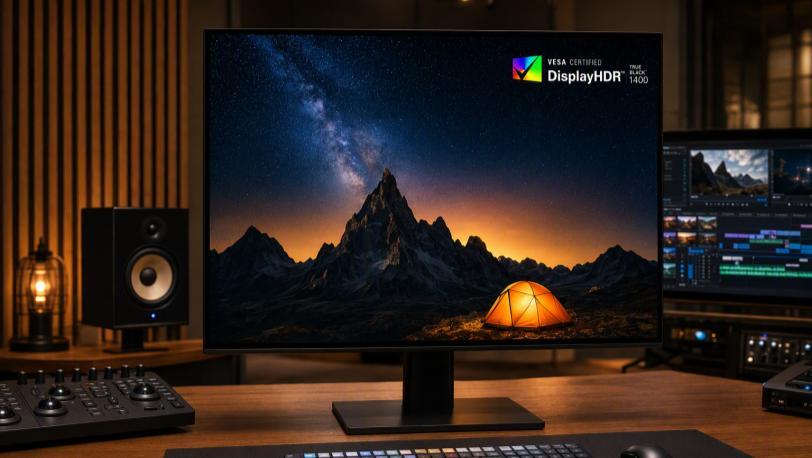
01 · TECHNICAL SPECIFICATION
An unfamiliar standard can still be real.
The “DisplayHDR True Black 1400” label looks questionable
without context. The investigation finds VESA documentation
introducing that certification tier in July 2026.
Decisive evidenceOfficial documentation
matches the visible designation.
Refuted
02 · TEMPORAL CONTEXT
The exhibition is real. The dates are not.
The poster shows 14 October 2025–1 February 2026. The
retrieved schedule instead gives 14 October 2026–1 February
2027.
Decisive evidenceA one-year discrepancy in
the event schedule.
Refuted
03 · EVENT STATE
A convincing scene at the wrong stage.
The image depicts an opening ceremony at a completed museum.
Project records show berlin modern was still under
construction at the paper’s assessment time.
Decisive evidenceThe depicted completion
conflicts with project status.
Supported
04 · EVENT VERIFICATION
An unusual event, backed by a source.
The investigation identifies the venue and event. France’s
Ministry of Culture confirms the launch at the Moulin Rouge on
21 January 2025.
Decisive evidenceAn official source connects
the event, venue, and date.
View the full qualitative comparison from the paper
EXPLORE THE PROJECT
Read. Reproduce. Build.
Start with the paper, explore the implementation, and find the
checkpoints and EviLens in one Hugging Face project.
01 / PAPER
The complete study
Method, benchmark, experiments, and additional analyses. The paper and original figures are in English.
@misc{wang2026evisceneisaiagentic,
  title={EviScene: Beyond "Is It AI?" for Agentic Image Factuality Assessment},
  author={ZiAn Wang and Ruiqi Liu and Zhengbo Zhang and Yi Han and
          Jialiang Shen and Ruoxin Chen and Manni Cui and Ximo Zhu and
          Jin Jiang and Mingzhe Liu and Linhao Wang and Wenhao Wang and Shu Wu},
  year={2026},
  eprint={2610.14609},
  archivePrefix={arXiv},
  primaryClass={cs.CV},
  url={https://arxiv.org/abs/2610.14609},
}